The current context is unprecedented and the need to innovate is very present. In the space of a few months, the way we work, the way we interact and therefore we live together has changed. Organizations need to innovate in the face of these new problems. They need to find solutions.
In this uncertain context, organizations need to innovate – to generate new ideas to meet a tangible and concrete need.
To generate new ideas, there are thousands of brainstorming exercises. The internet is full of ways to use post-it notes to think “out of the box.” In fact, we talk about it in one of our online courses: Generating Ideas.
While ideation techniques are important, the first thing to do is to make sure you have the right posture.
The ability to generate new ideas is found in openness, in accepting the ideas of others, and in listening.
Without this posture, post-it notes are of little use:)
Convergence or divergence?
The first phase of innovation is characterized by divergence. We want to make sure that before choosing the solutions to be put in place to respond to the problem, that all possible options have been explored.
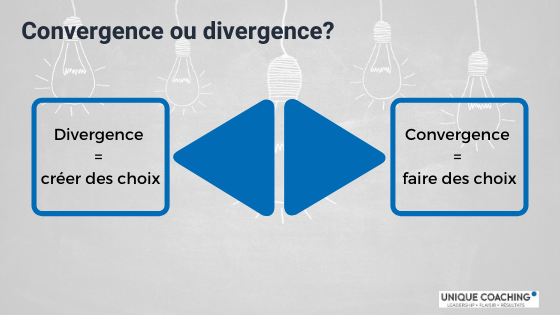
Divergence is creating choices, while convergence is making choices.
An interesting key to embodying this posture of openness that the need to innovate requires is to accept more of the ideas of others and to improve one’s listening.
This posture will become more easily accessible to each participant by using the “Yes, and” button.
The origin of the “Yes and” and the link with the need to innovate
Drawn from the world of theatrical improvisation, the “yes, and” consists of listening to new proposals, accepting them and building on them. The “Yes, and” is essential for improvisers and is the first thing they are taught.
When you think about it, improvisation is the very embodiment of acting in uncertainty!
The actors enter the stage having no idea what they will be playing in the next hour! However, they are confident that they will be able to create something new, in the moment, because they know that all the proposals they bring forward will be met with a “Yes, and”.
If one comedian starts the scene by saying to the other comedian, “Wow, what rain today” and the other responds with “No, it’s sunny.” Hop, the scene ends in great discomfort (for the actors and for the audience).
Otherwise, if the other responds with “Yes, what rain. What if we went to the movies.” Hop, the scene continues. It is through the “Yes, and” that improvisers arrive at a completely new result by building step by step, idea by idea.
Test the “Yes, and”
So here’s an exercise you can do with your team before an ideation session to practice this concept of “Yes, and.”
Start with the opposite… play the game of No!
Offer your team a first scenario, i.e. “Organize a picnic in “No” mode.
A first participant will propose an idea. The second will answer with “No [with an excuse]. The third participant will propose a new idea. To which the fourth participant will also answer “No [with an excuse]”. And so on.
Make sure everyone is in “No” mode, it’s a game!
Now offer your team a second scenario, “Plan a long weekend in “yes, and” mode.
A first participant will propose an idea. The second will answer with “Yes, and [with a new idea that builds on it]”. The next participant will also answer “Yes, and [with a new idea that builds on it]. And so on.
Make sure everyone plays the game!
Then take a moment to reflect as a group and discuss:
• What is the difference in energy between “No” and “Yes, and”?
• What did you notice about the ideas generated?
• In what situation do you tend to go “No” versus “Yes, and”?
And so, if you need to innovate…
In times of stress, uncertainty, our natural tendency can lead us to unconsciously answer “No” or “Yes, but” (a disguised “no”!) because it brings us a sense of control.
Be careful, after a while, if we always answer “No” the members of our team will tend to not propose any more ideas… ideas we need to innovate!
To meet the need to innovate and therefore have access to all the ideas, experience and creativity of our team members, give yourself permission to diverge… before converging and taking action!
We can support your team to better act in uncertainty with our relevant, concrete and tool-filled virtual training . Contact us about this.